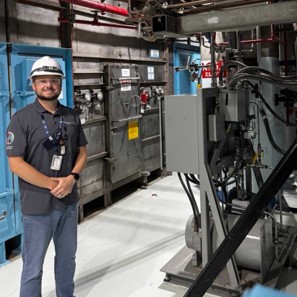
When you spend years working around valves, actuators and high‑pressure systems, you learn that the energy you can’t see is often the energy that matters most. That perspective is second nature to Wesley Averette, a mechanical maintenance planner at Watts Bar. He has spent much of his career around components that store, move or release pressure and his experience shows why recognizing that energy is so important.
Wesley joined TVA in 2016 after working as a contractor on Unit 2 construction and startup testing. His early work put him inside tight spaces, around critical components and face-to-face with systems designed to hold back significant force. Today, his job involves walking down work orders, reviewing the condition of valves and systems and preparing safe, accurate work packages. It’s a role built on understanding how things behave when pressure is involved.
He first encountered Energy-Based Safety about a year ago, when his manager asked him to attend a train-the-trainer session. He didn’t know what to expect, but the visual approach of the Energy Wheel stood out. “I’d never seen hazards broken down this way,” he said. “It gives you a wider view of what could hurt you, especially the things you might not consider at first.”
One moment from earlier in his career illustrates how pressure can catch people off guard. During startup testing at Watts Bar Unit 2, he and several co‑workers were monitoring a large valve as operations prepared to cycle it. The room was quiet, as they focused on the mechanical movement. No one thought much about the volume of air that would vent from the actuator when the valve moved.
“When the valve stroked, it dumped a huge amount of air all at once,” Wesley said. “It blew the hard hat off the guy next to me. He had his face right where the pressure was going to come out, and none of us realized it.” The noise, the sudden force and the unexpected movement all hit at once. It wasn’t a serious injury, but it easily could have been.
Looking back, he sees the moment differently now that he uses the Energy Wheel. The situation involved several forms of energy, but pressure was the one that mattered most. “If we had taken a minute to think through where that air was going to vent, we would have positioned ourselves differently,” he said. “The Energy Wheel helps you slow down and look at more than one thing. It keeps you from having tunnel vision.”
Pressure comes with its own challenges because it isn’t always visible. It can exist inside a line, a vessel or an actuator without any obvious signs. “Assume it’s there until you prove otherwise,” Wesley said. “Don’t take for granted that something is contained the way you expect.”
Pressure makes up just one wedge of the wheel, but it connects to decisions people make every day. A small pause to consider where pressure is stored, where it will release and who may be near it can prevent serious injuries. It builds the habit of looking beyond the surface of a job, which is exactly what Energy-Based Safety aims to support.
As TVA continues using the Energy Wheel in classrooms and job briefings across the Tennessee Valley region, stories like Wesley’s help bring each type of energy to life. Pressure isn’t always dramatic, but when it’s underestimated, it can make a routine moment dangerous. Recognizing it before the work begins is one more way employees protect themselves and each other while keeping TVA’s mission moving safely forward.